Broken key stuck in the lock: DIY removal vs calling a locksmith

A key snaps off in the lock cylinder. Half of it is in your hand. The other half is wedged inside the lock, far enough in that you cannot grab it with your fingers. The door is locked. You have somewhere to be.
What you do in the next 90 seconds determines whether this is a $20 problem or a $300 problem.
The 90-second decision: try to extract it yourself with the right tool, or stop touching the lock and call a locksmith. The wrong answer is the most common one, which is "try to push it deeper with another key to make it work." That move turns a $20 extraction into a $300 cylinder replacement.
This piece walks through why keys break, how to safely attempt DIY extraction, when to stop, and what a legitimate locksmith should charge for the job.
Why keys break in NYC apartment locks
Keys break for one of four reasons. The reason matters because it changes the right repair.
Metal fatigue. Keys made of brass or low-grade nickel silver wear over years of use. Repeated bending in the same direction (typical of a key that catches slightly when inserted) eventually creates a stress fracture that breaks under normal turning force. This is the most common cause in NYC apartments, where the same key is used 1,500 to 3,000 times per year.
Worn lock cylinder. A pin tumbler with worn pins or accumulated debris creates inconsistent resistance. The key requires more torque to turn, which over time exceeds the key's strength. The key breaks but the underlying problem is the lock.
Forced rotation against a misaligned bolt. When a door is misaligned (sagging hinges, warped frame from humidity), the bolt does not extend or retract smoothly. The user applies more force to the key, and the key breaks before the bolt moves.
Wrong key. A key for a similar lock model that almost fits but does not turn cleanly. Forcing it produces a break.
Each cause has a different downstream consequence. A fatigued key breaking in a healthy lock is a $20 extraction job. A key breaking because the cylinder is worn or the door is misaligned is the symptom of a $150 to $400 deeper repair. The locksmith assessment after extraction is what tells you which it is.
What not to do in the first 90 seconds
Three actions make the problem dramatically worse and are reflexively common.
Do not push another key in to try to push the broken piece further. This wedges the broken piece deeper, often past the point where extractor tools can reach. The fix changes from extraction to drilling the cylinder.
Do not turn the broken key fragment with a screwdriver or knife. Forcing the fragment rotates the cylinder partially, sometimes locking it in a position where the lock is neither locked nor unlocked. The fix changes from extraction to disassembling the lock from inside the door, which usually requires removing the cylinder.
Do not apply lubricant before attempting extraction. WD-40 or graphite seems intuitive but typically makes the fragment harder to grip with an extractor. If lubricant is needed, the locksmith will apply it.
The right initial action is to leave the lock untouched and assess the extraction options.
DIY extraction: when it works and when to stop
DIY extraction can succeed in roughly half of broken-key cases. The conditions for success:
The broken fragment is visible at the keyway opening. If you can see at least 1mm of metal inside the cylinder, an extractor tool has something to grip.
The fragment did not rotate within the cylinder. If the break happened during insertion or pulling out, the fragment is usually straight in the keyway. If it happened during turning, the fragment may be at an angle and harder to reach.
You have access to a proper extraction tool. Not a paperclip. Not a knife. A real broken-key extractor.
The proper tool is a key extractor, which costs $8 to $20 at locksmith supply stores or Amazon. It is a thin metal hook designed to fit alongside the broken fragment and grip it from underneath. Some kits include multiple shapes (single hook, double hook, jigsaw blade).
The technique:
- Look at the keyway with a flashlight. Identify the broken fragment's position.
- Insert the extractor along one side of the fragment, parallel to it.
- Rotate the extractor slightly so the hook engages the fragment.
- Pull straight out, with steady pressure. Do not yank.
- The fragment should come out with the extractor.
If the first attempt fails, try once more with the extractor at a different angle. After two failed attempts, stop. Continued attempts increase the risk of pushing the fragment deeper or damaging the cylinder.
When to stop and call a locksmith
Five clear signals that DIY is the wrong path.
You do not have the right tool. Substituting a paperclip, tweezers, or super glue almost always makes the problem worse. Order an extractor (Amazon Prime delivers same-day in NYC) or call a locksmith.
The fragment is not visible from the keyway opening. Without something to grip, no extractor will work. Drilling is needed; this is a locksmith job.
The cylinder turns partially. This usually means the fragment rotated. Continued attempts can lock the cylinder in a state requiring disassembly.
You have already made two failed attempts. The success probability on the third attempt is significantly lower, and the damage probability is significantly higher.
You need the door open in the next hour. A locksmith arrival in 30 to 75 minutes plus 15 minutes of extraction is faster than 45 minutes of failed DIY attempts followed by a locksmith call. The clock matters.
What a locksmith should charge for broken key extraction
Real 2026 NYC pricing for broken key extraction:
Standard hours (8 AM to 8 PM), straightforward extraction. $50 to $150. This is the typical case: visible fragment, healthy cylinder, 5-10 minutes of work.
Overnight or weekend, straightforward extraction. $80 to $200. The after-hours surcharge applies.
Complicated extraction (fragment deep, cylinder damaged, partial rotation). $100 to $250 for the extraction, plus any cylinder replacement charge if the lock is damaged.
Extraction plus cylinder replacement. $200 to $500 total. This is the worst-case scenario, typically caused by DIY attempts that pushed the fragment too deep.
The full range of NYC locksmith pricing is in the 2026 NYC locksmith cost guide. Anything significantly above these ranges, or any locksmith who claims the cylinder "has to be replaced" without first attempting extraction, should trigger the verification checklist.
The hidden lesson: a key that breaks is usually telling you something
A key that breaks unexpectedly is often the second or third sign that the lock or the key was already in trouble. The first signs are typically subtle and ignored.
Three warning signs that a key break is approaching:
The key catches slightly during insertion or removal. Smooth keys insert and pull without resistance. A key that catches is bending slightly each time, accumulating stress.
Turning requires more force than it used to. Worn pins or misaligned bolts increase torque demand. The key bears the increased load.
The key has visible bend or warp. Hold the key on a flat surface. If it does not lie flat, the key is already partially deformed and will break sooner.
When any of these appear, replace the key (cost: $3 to $5 for a duplicate at a hardware store) before it breaks in the lock at the worst moment. If multiple keys are showing the same wear, the underlying issue is the lock cylinder, and a rekey or replacement may be due. Full decision framework in rekey vs replace: when each one makes sense.
What a platform-booked locksmith call looks like for this job
For a broken key extraction, the booking flow is straightforward.
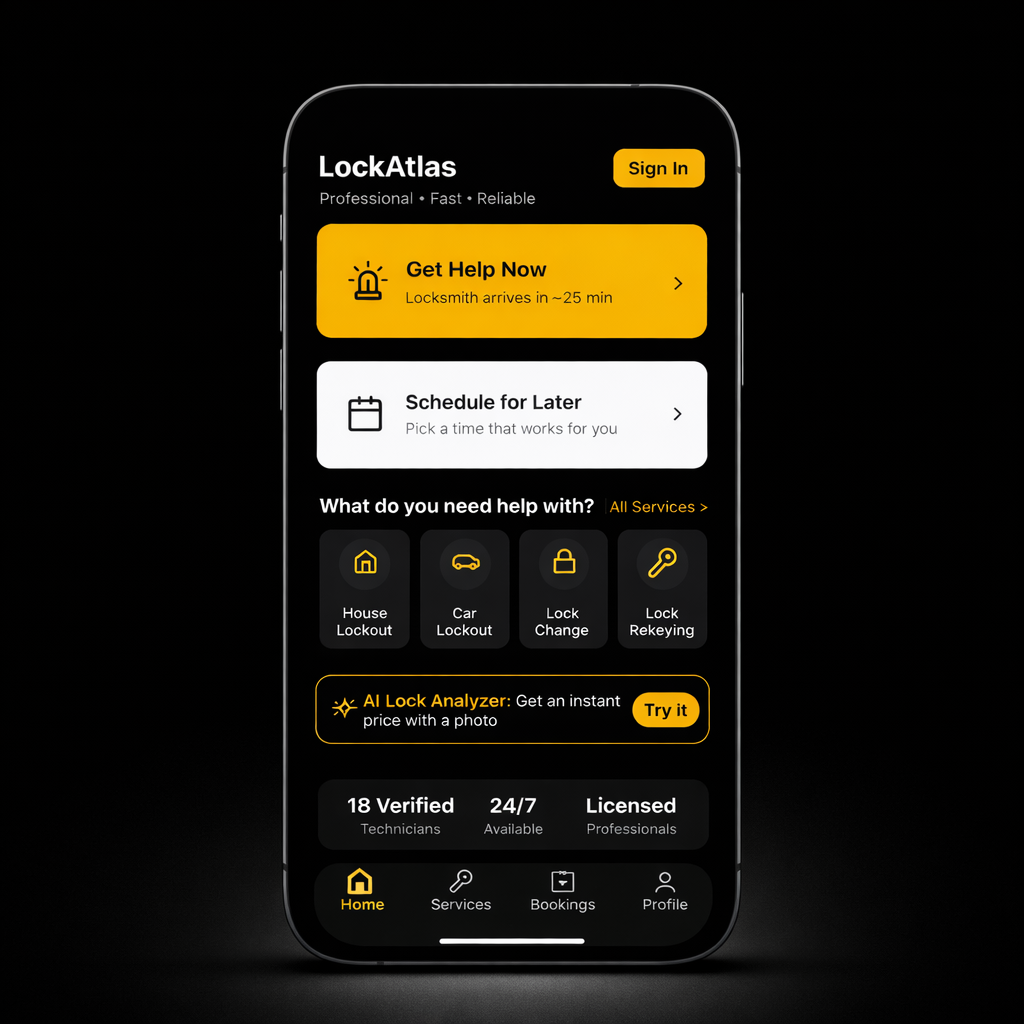
The customer photographs the lock face with the broken key visible at the keyway. The platform identifies the lock type, brand, and visible state of the fragment. The price is calculated: typically $80 to $180 in standard hours for a standard cylinder with visible fragment, $130 to $250 overnight.
The technician arrives, attempts extraction with proper tools, and either succeeds (no additional charge) or escalates to drilling-plus-replacement only after the customer approves the new price in the app. No on-site improvisation.
The full mechanism is described on the LockAtlas download page.
This matters specifically for broken-key situations because the natural escalation path ("we tried, couldn't get it, have to drill and replace") is the exact bait-and-switch pattern documented elsewhere in this series. The platform structure forces transparent price decisions for each escalation, which is the structural fix.
FAQ
Can I use super glue to extract a broken key?
This is a popular YouTube technique. It rarely works in practice and often makes things worse. Super glue dripped into the keyway typically bonds the fragment to the cylinder pins instead of to the extraction tool. The cylinder then has to be drilled or disassembled to clean out the glue. Skip this method.
What if the lock still works with the broken piece inside?
If the cylinder rotates and the bolt extends and retracts normally, the lock is functionally working with the fragment embedded. This is not stable: the fragment will eventually shift, the cylinder will jam, and the problem becomes harder to fix. Schedule the extraction within a week.
Can a hardware store extract a broken key?
Most hardware stores will not. They are not licensed locksmiths and the liability is real. Some hardware stores have an in-house key counter operator who can attempt extraction informally, but this is not standard. Use a DCWP-licensed locksmith.
What if the broken key is in my car ignition?
Car ignitions are a different category. The extraction process is similar but the underlying ignition cylinder is significantly more complex than a residential pin tumbler. Cost is typically $100 to $250 for a standard vehicle. Some vehicles (modern BMW, Mercedes, Audi) have electronic immobilizer ignitions where the dealer may be faster than a locksmith.
Does insurance cover broken key extraction?
Renters insurance and homeowners insurance typically do not cover lock issues unless they are part of a covered incident (break-in, fire, water damage). Routine maintenance items like key breakage are out of pocket.
A broken key in the lock is a small problem that becomes a big problem only through wrong choices in the first two minutes. The right choice is either careful DIY with proper tools or a locksmith call within the first attempt. The wrong choice is forcing additional keys, knives, or screwdrivers into the cylinder. The full lockout-decision context is in locked out of your apartment at 2 AM. The pricing benchmarks for verifying any locksmith quote on this job are in the 2026 NYC locksmith cost guide.
Related reading: frozen lock in NYC winter: how to thaw and prevent. lost your only key in Manhattan: 24-hour playbook.
LockAtlas is live now on the App Store and Google Play, serving all five boroughs of NYC. Questions or partnerships: support@lockatlas.com
Customer app (book a verified NYC locksmith)
- iOS: LockAtlas on the App Store
- Android: LockAtlas on Google Play
Technician app (apply to receive jobs)


Need a Locksmith in NYC?
Use the LockAtlas app to describe the work, review the price breakdown and check your booking details.
Download the App