Medeco vs Mul-T-Lock vs Schlage: choosing the right high-security lock for your NYC apartment
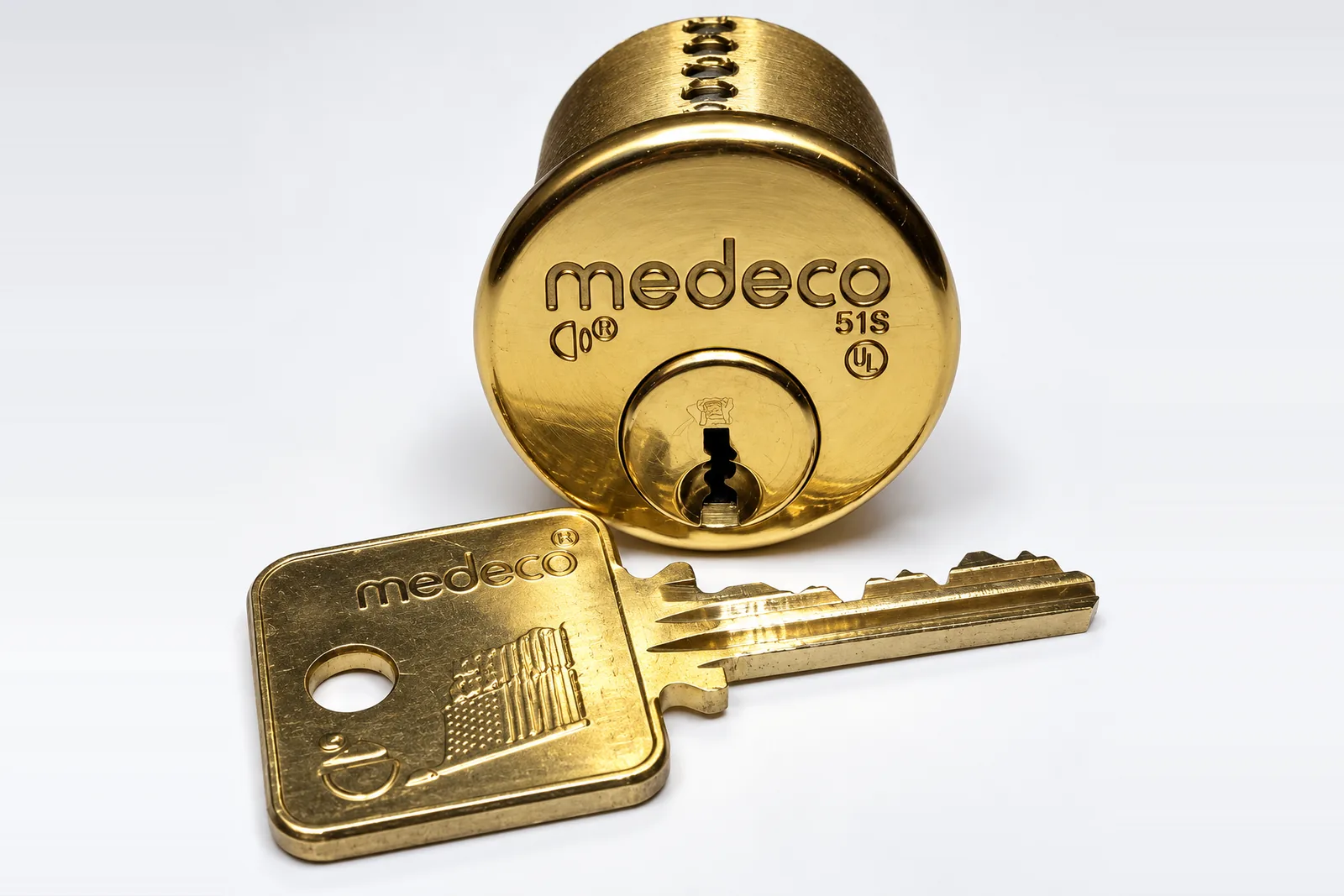
Most NYC apartment doors are protected by a $25 Kwikset or unbranded cylinder that picks open in under three minutes. That is not a security flaw in the lock. It is a category mistake. The category is "consumer-grade pin tumbler." It was never designed to resist a skilled attacker. It was designed to resist a casual one.
The category that actually resists a determined attack is called high-security, and in NYC apartments the three brands worth comparing are Medeco, Mul-T-Lock, and Schlage Primus. The differences between them matter. The differences between any of them and a standard cylinder matter far more.
This piece walks through what each brand actually does, how the three compare on the security factors that matter in NYC, and how to decide which one to install if you are upgrading.
What "high-security lock" actually means
A high-security lock is not a marketing label. It is a category defined by independent testing standards, most commonly UL 437 and ANSI/BHMA Grade 1. To carry the label, a lock has to resist three specific attacks for specified durations:
- Picking. Resist single-pin manipulation for at least 10 minutes.
- Drilling. Resist a drill attack for at least 5 minutes, typically through hardened steel inserts at the most-attacked points.
- Bumping. Resist the bump-key attack entirely, usually through anti-bump pin designs.
A lock that does not meet all three is not high-security, regardless of what the marketing says. Most locks sold at hardware stores under $80 do not meet any of the three.
The reason this matters in NYC: the locksmith techniques most commonly used in residential lockouts (lock picking, drilling) are the same techniques used in actual break-ins. A lock that holds against a legitimate locksmith for an hour also holds against a burglar for an hour. The threat model is more aligned than most people realize.
Medeco: angled-pin design, restricted keyways, high-end NYC default
Medeco is the brand most NYC building managers default to when "high-security upgrade" is in the budget. The design dates to 1968 and uses two innovations: angled pins that have to be rotated to specific angles to align, and restricted keyways that limit who can cut a duplicate key.
Security strengths. Medeco's pin design adds a rotational element on top of the standard pin-height alignment. Picking requires the attacker to manipulate both height and rotation for each pin simultaneously. UL 437 certified for picking, drilling, and bumping resistance.
Key control. Medeco runs a restricted keyway program. Duplicate keys can only be cut by authorized dealers, with documentation. This matters for tenants whose landlord changes management companies, for shared apartments where roommates leave, and for any situation where the chain of custody of the key matters.
NYC-specific notes. Many NYC co-ops and condos use Medeco as their building-standard high-security lock. Some boards mandate it. If your building uses Medeco for the lobby, the apartment door is usually also a candidate.
Cost. Medeco cylinders run $150 to $300. Installation by a DCWP-licensed locksmith adds $100 to $200. Total per cylinder: $250 to $500. A standard 2-cylinder NYC apartment runs $500 to $1,000 fully installed.
Weakness. Like all locks, Medeco can be defeated given enough time and the right tools. Documented attacks exist but require specialized knowledge and 20+ minutes of work at the door, which exceeds the patience of most opportunistic break-ins.
Mul-T-Lock: telescoping-pin design, common in commercial and luxury residential
Mul-T-Lock is Israeli, originally a commercial lock, and increasingly common in NYC luxury residential. The design uses a telescoping pin where each pin is actually two pins nested inside each other.
Security strengths. The telescoping pin design requires the attacker to align both an inner and outer pin for each position. The picking time is significantly higher than a standard cylinder, typically over an hour for a skilled picker. UL 437 certified.
Key control. Mul-T-Lock runs a restricted keyway program comparable to Medeco. Duplicate keys require documentation and an authorized dealer.
NYC-specific notes. More common in newer construction and luxury buildings than in pre-war walk-ups. If you are moving into a building constructed after 2000 with a "high-security" lock, it is often a Mul-T-Lock.
Cost. Cylinders run $180 to $350. Installation $100 to $200. Total per cylinder $280 to $550. Slightly higher than Medeco on average.
Weakness. The telescoping pin design, while harder to pick, is somewhat easier to drill in certain configurations than Medeco. A skilled drill attack on Mul-T-Lock can succeed in 8 to 12 minutes; on Medeco, typically 15 to 25 minutes. This is a narrow difference that matters mostly in commercial security contexts, less for residential.
Schlage Primus: pin-tumbler with side bar, mid-tier high-security
Schlage Primus is the entry point to high-security from a brand most NYC apartment dwellers already recognize. The standard Schlage cylinder is consumer-grade. The Primus version adds a side-bar mechanism and restricted keyway.
Security strengths. The side bar requires the attacker to manipulate an additional element beyond the pin heights. Picking time is significantly longer than standard Schlage but typically faster than Medeco. UL 437 certified.
Key control. Schlage Primus runs a restricted keyway program. Slightly more accessible duplicate-key infrastructure than Medeco or Mul-T-Lock because Schlage has wider dealer presence.
NYC-specific notes. Often the cost-effective choice for tenants upgrading their own locks without a building mandate. Compatible with many existing Schlage door hardware setups, which lowers installation cost.
Cost. Cylinders run $120 to $220. Installation $100 to $200. Total per cylinder $220 to $420. Lowest of the three high-security options.
Weakness. Picking resistance is real but lower than Medeco or Mul-T-Lock. For most NYC residential threat models, this difference is academic. For a target-rich apartment (high-value contents, ground floor, fire-escape access), the higher-tier option is worth the cost difference.
How to choose between the three
The decision tree is shorter than the brand differences suggest.
If your building has a standard lock and you are upgrading on your own dime: Schlage Primus. Best price-to-security ratio. Compatible with most existing hardware.
If your building mandates a specific brand: Whatever the building mandates, almost always Medeco or Mul-T-Lock. Building-wide standards exist for master key compatibility; deviating breaks the building's key system.
If you have a high-value threat model (high-value contents, vulnerable entry point, prior break-in attempt): Medeco. The picking and drilling resistance is the highest of the three for residential applications.
If you are in a luxury or new-construction building that defaults to Mul-T-Lock: Mul-T-Lock. Maintains compatibility with the building's existing keying.
None of the three is meaningfully better for the typical NYC apartment with a typical NYC threat model. The order-of-magnitude jump is from consumer-grade to any high-security. The differences between the three high-security brands are real but second-order.
What this changes about the locksmith conversation
Two things change when your apartment has a high-security lock instead of a standard one.
The lockout price goes up. A standard residential lockout in NYC runs $80 to $220 during standard hours. A high-security residential lockout runs $150 to $400. The cost benchmarks are in the 2026 NYC locksmith cost guide. The reason is that high-security locks require longer picking times, more specialized tools, or drilling with replacement parts.
The drill-instead-of-pick scam pattern changes. With a standard cylinder, a technician who claims the lock cannot be picked is running the bait-and-switch. With a Medeco or Mul-T-Lock, the claim is sometimes legitimate; picking these locks can take 20 to 45 minutes, and at 2 AM the customer may genuinely prefer drilling. The verification step is to ask the technician to attempt picking for a set time before drilling. A 15-minute attempt is reasonable. A no-attempt declaration is the warning sign documented in the bait-and-switch explainer.
Installation, key control, and the parts most people miss
Installing a high-security lock is not the whole upgrade. Three other factors determine whether the lock actually does what it is supposed to.
The strike plate. A high-security lock with a weak strike plate (the metal piece on the door frame that the bolt extends into) is a high-security lock that comes apart with a kick. Upgrade the strike plate at the same time. A 3-inch-screw heavy-duty strike plate adds $20 to $40 in parts and 5 minutes of labor.
The door itself. Hollow-core or thin steel doors compromise any lock. NYC apartment doors are typically solid-core wood or steel, which is fine, but inspect the door for damage or rot near the lock area before installing.
Key control discipline. A high-security lock with copies of the key floating around (former roommates, building staff, previous tenants) is a high-security lock that does not actually secure anything. Rekey on move-in, and ask about key control when you request high-security lock installation in NYC. The full process is in moving into a NYC apartment: the 7-day lock checklist.
FAQ
Can I install a high-security lock myself?
Mechanically, yes. The lock fits a standard cylinder mount in most cases. In practice, the alignment and strike plate work benefit from a DCWP-licensed locksmith. The labor cost is $100 to $200; the cost of misalignment is a lock that does not extend its bolt fully and is therefore not secure.
What if my landlord refuses to allow a lock change?
Multiple Dwelling Law § 51-c covers a separate tenant lock on an eligible apartment entrance, apart from the owner's lock, with a limit of three inches in circumference and a duplicate key supplied on request. It excludes municipal housing authority units, hotels, motels, and school or college dormitories. It does not give blanket permission to replace or rekey the owner's lock, modify shared doors, or install any chosen device. Check the proposed work against your lease and applicable building requirements before scheduling.
Are smart locks comparable to high-security locks?
No. Smart locks (August, Schlage Encode, Yale Assure) provide convenience and electronic key management. Their physical security is generally consumer-grade pin tumbler, not UL 437. A smart lock plus a high-security deadbolt is a reasonable combination. A smart lock alone is not a security upgrade. The full comparison is in smart locks in NYC rentals: what your landlord can refuse.
How often should a high-security lock be rekeyed?
Whenever the set of authorized key-holders changes. Roommate moves out: rekey. Estranged partner: rekey. Building changes management companies: rekey. The cost is $25 to $50 per cylinder if the lock itself does not need replacing. Full pricing is in rekey vs replace: when each makes sense.
Is a $500 lock actually 10x more secure than a $50 lock?
In terms of time-to-defeat, yes, often more. A standard cylinder picks in 3 minutes. A Medeco picks in 20 to 30 minutes. The picking time is the relevant security variable for opportunistic break-ins, which are time-constrained. For a determined targeted attack, no lock is sufficient on its own, and the security strategy shifts to alarms, cameras, and 24-hour monitoring.
The high-security lock is the foundation of NYC residential security but it is one element. The strike plate, the door, the key control, and the verified locksmith for installation all matter. The full integrated approach is in moving into a NYC apartment: the 7-day lock checklist and rekey vs replace: when each makes sense.
Related reading: door frame reinforcement: strike plates and hinges. restricted keyways: key control for NYC tenants. ANSI deadbolt grades explained for NYC apartments.
Once you have chosen between them, the fitting matters as much as the brand: a high-security cylinder in a weak door or a worn frame protects very little. Our lock installation service in NYC covers what to send so the quote accounts for your actual door, and you review the breakdown before booking.
LockAtlas is live now on the App Store and Google Play, serving all five boroughs of NYC. Questions or partnerships: support@lockatlas.com
Customer app (book a verified NYC locksmith)
- iOS: LockAtlas on the App Store
- Android: LockAtlas on Google Play
Technician app (apply to receive jobs)


Need a Locksmith in NYC?
Use the LockAtlas app to describe the work, review the price breakdown and check your booking details.
Download the App